
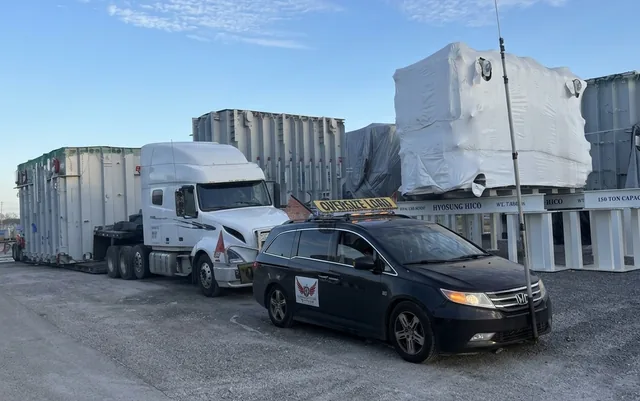
A bigger load leaves a smaller margin
FHWA's guidance on load movement explains why: oversize loads take longer to stop and accelerate, have larger blind spots, swing wide on turns, and have trouble gaining speed on ramps or braking on long downgrades. When the driver is working that hard to control the vehicle, it helps to have someone else watching the road.
Route awareness
Before the move, escort operators are expected to understand the permit and the route. FHWA recommends comparing the permitted route against an actual map and against construction and seasonal restrictions, and reviewing railroad crossings, overpasses and weight-restricted bridges. On the road, the lead car turns that preparation into real-time awareness of what is ahead.
Communication
A pilot car is the load driver's link to the road. Using two-way radio, the operator can say "slow down, stopped traffic ahead" or "narrow bridge, oncoming truck" while there is still time to respond. FHWA also stresses that every member of the team should understand the plan and feel free to speak up or stop the move if something looks wrong.
Hazard awareness
The lead operator watches for oncoming traffic, stranded vehicles, pedestrians, congestion, upcoming turns, work zones and edge drop-offs. The rear operator watches traffic approaching from behind and checks the load itself for shifting cargo, tire problems or light failures. Between them, they cover the places the load driver cannot easily see.
Coordination with the hauling team
Before moving, FHWA recommends the team review paperwork, equipment, the first turns, traffic control plans, the radio channel and emergency steps. That shared plan matters when something goes wrong, such as a breakdown or a blocked crossing. The load driver still makes the final call about their own vehicle, for example whether to cross a railroad crossing.
Protecting other road users
Amber lights, flags and signs tell other drivers that something unusual is coming. A pilot car also helps hold space around the load so passing traffic does not cut in. Pilot car operators are still bound by the same traffic laws as everyone else: FHWA is clear that they must obey signs, signals and speed limits.
What a pilot car does not do
A pilot car does not replace a valid permit, a route survey, or the load driver's judgment. It adds awareness and communication to a plan that is already sound.
Plan your escort with us
If you are moving an oversize load, our dispatch team can help you work out which positions to book. See our pilot car services or send us your route.