
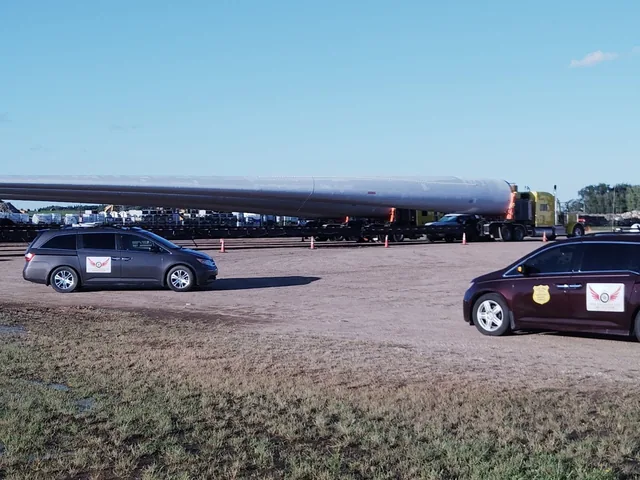
The lead (front) pilot car
The lead car acts as the load's eyes. FHWA's guidance on load movement describes keeping an attentive visual lead as perhaps the most important skill for the front operator. That means watching for oncoming traffic, especially other large vehicles, stranded vehicles, pedestrians, congestion, upcoming turns, work zones and potholes or drop-offs on ramps.
FHWA recommends a visual lead of at least 20 seconds for oversize movement, with more time added for wet roads, darkness, hills, curves or heavy traffic. In practice, that is why the lead car is often well ahead of the load rather than right in front of it.
The chase (rear) pilot car
The chase car follows the load. It watches traffic coming from behind, helps keep other drivers from crowding the trailer, and "protects" the lane when the load needs to change lanes or merge. FHWA adds that the rear operator also watches the load and load vehicle, reporting shifting cargo, loose tie-downs, tire problems or brake and tail light issues.
On a grade, the rear car has another job: FHWA notes an oversize load may roll backward when first engaging gears on an incline, so the rear operator should keep other vehicles from getting too close.
Side by side
- Position: lead is in front, chase is behind.
- Main focus: lead looks ahead at the road and obstacles. Chase looks behind at traffic and at the load.
- Typical use: two-lane roads often call for a lead escort. Divided highways often call for a rear escort. Wider or longer loads may call for both.
When each is required
The permit controls. As one example of how specific it can be, Mississippi DOT's over-dimensional permit rules say that in daylight a load 13 feet wide or greater on a two-lane road requires at least a front escort and rear amber lights, while on a divided highway it requires at least a rear escort and rear amber lights. The same rules allow the department to require both a front and rear escort when it considers it necessary. Other states set their own thresholds, so never assume one state's rule applies in the next.
Working as a team
When both are on a move, the lead and chase operators stay in contact with each other and the load driver on the same radio channel and share what they see. A tall load adds a high pole to the lead position, and a long steerable trailer may add steering support.
Book the right positions
Not sure which you need? Send us your permit and route and we will help you confirm. See our lead and chase pilot car services, or request a quote.