
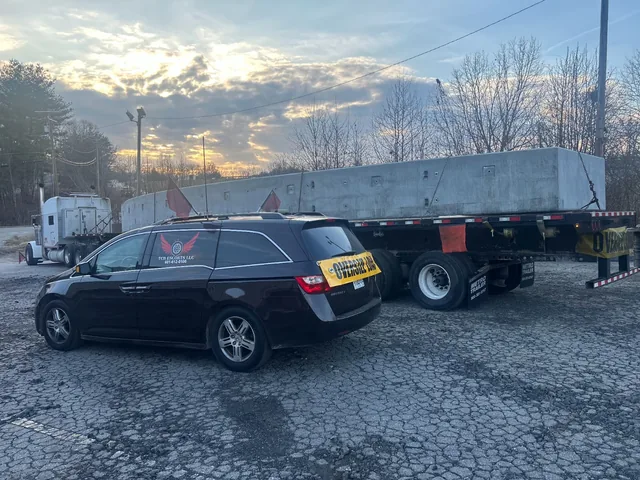
The permit is the authority
You may hear rules of thumb such as "over 12 feet wide needs an escort." Treat them as rough guesses. FHWA's guidance on load movement explains that each carrier needs a permit for every state the load travels through, and that the permit typically sets the route, the dates and times, and the number of escorts. Your permit, not a number someone remembers, decides.
What usually drives the requirement
- Width: wider loads are more likely to need escorts, and more of them.
- Length and overhang: very long loads and loads that extend far past the trailer can trigger escorts.
- Height: tall loads may need a high pole.
- Road type: a two-lane road leaves less room than a divided highway.
- Time of day and weather: night moves and poor visibility often come with extra conditions.
- Route hazards: bridges, railroad crossings, work zones and tight turns can lead a state to add conditions.
One state's example: Mississippi
To show how specific this gets, here is what Mississippi DOT's over-dimensional permit rules say today. It is an illustration only; rules can change and other states differ.
- In daylight on a two-lane road, a load 13 feet wide or greater requires at least a front escort and rear amber lights. On a divided highway, it requires at least a rear escort and rear amber lights.
- A rear overhang of 15 feet or more requires a permit and a front and/or rear escort, as does a front projection of 15 feet or more.
- A vehicle over 99 feet in total length requires a permit and a front and/or rear escort.
- Police escorts may be required for loads 20 feet wide and over, depending on the route.
- Night movement has its own escort rules.
Law enforcement escorts
Some permits require police escorts in addition to civilian pilot cars. If yours does, your pilot car company should coordinate with them. FHWA publishes separate guidance for that.
Adding an escort the permit does not require
Sometimes it is simply smart. A difficult route with tight turns or heavy traffic may justify a lead car even if the permit does not demand one. Your carrier decides, and a good pilot car company can help weigh it.
Check before you move
Send us your dimensions, route and permit and we will help you work out the right positions. Request a quote, or see how requirements vary by state and lead vs. chase.